Example 2: Forward modeling of RT model combination (surface + canopy part)
1. Narrative (Examples of different model combination (surface + canopy part))
This notebook demonstrates model combinations of
Dubois95 + SSRT
Oh04 + WaterCloud
A short overview of the required input parameters can be found here.
2. Requirements
Installation of SenSE
3. Required imports
import numpy as np
from sense.util import f2lam
from sense.model import RTModel
from sense.soil import Soil
from sense.canopy import OneLayer
import matplotlib.pyplot as plt
4. Dubois95+SSRT for different incidence angles
4.1 Input parameters for the RT model combination
# array with different incidence angles in radians
theta_deg = np.arange(0.,70.)
theta = np.deg2rad(theta_deg) # incidence angle [radians]

# soil model parameters
f  = 13.  # frequency [GHz]
lam = f2lam(f)  # wavelength [m]
s = 0.15/100.  # surface roughness [m]
eps = 15. - 4.0j # dielectric constant

# canopy parameters for short alfalfa
d = 0.17 # vegetation height [m]
tau = 2.5 # optical depths
ke = tau/d # extinction coefficient [m⁻¹]
omega = 0.27 # scattering albedo
ks=omega*ke
4.2 Forward modeling of RT model combination Dubois95 and SSRT (rayleigh scattering)
First model run with model parameters for small alfalfa
# Define models and polarization to be used
models = {'surface' : 'Dubois95', 'canopy' : 'turbid_rayleigh'} # For SSRT two scattering models are implemented 'turbid_rayleigh' and 'turbid_isotropic'
# models = {'surface' : 'Oh92', 'canopy' : 'turbid_isotropic'} # alternative with different surface and canopy models
pol='vv' # target polarization

# Soil model initialization based on previously defined input parameters
S = Soil(f=f, s=s, eps=eps)

# Canopy model initialization based on previously defined input parameters
C = OneLayer(ke_h=ke, ke_v=ke, d=d, ks_v=ks, ks_h=ks, canopy=models['canopy'])

# Combined Model initialization
RT = RTModel(theta=theta, models=models, surface=S, canopy=C, freq=f)

# Run RT model
RT.sigma0()
back_short = RT.stot[pol]
/home/docs/checkouts/readthedocs.org/user_builds/sense-community-sar-scattering-model/envs/dev/lib/python3.10/site-packages/sense/surface/dubois95.py:42: RuntimeWarning: divide by zero encountered in divide
  b = 10**-2.35 * (np.cos(self.theta) ** 3) / (np.sin(self.theta) ** 3)
/home/docs/checkouts/readthedocs.org/user_builds/sense-community-sar-scattering-model/envs/dev/lib/python3.10/site-packages/sense/surface/dubois95.py:45: RuntimeWarning: invalid value encountered in multiply
  return b * c * d
/home/docs/checkouts/readthedocs.org/user_builds/sense-community-sar-scattering-model/envs/dev/lib/python3.10/site-packages/sense/surface/dubois95.py:35: RuntimeWarning: divide by zero encountered in divide
  a = 10**-2.75 * (np.cos(self.theta) ** 1.5) / (np.sin(self.theta) ** 5)
/home/docs/checkouts/readthedocs.org/user_builds/sense-community-sar-scattering-model/envs/dev/lib/python3.10/site-packages/sense/surface/dubois95.py:38: RuntimeWarning: invalid value encountered in multiply
  return a * c * d
Second model run with model parameters (canopy) for tall alfalfa
# redefine canopy parameters for tall alfalfa
d = 0.55 # vegetation height [m]
tau = 0.45 # optical depths
ke = tau/d # extinction coefficient [m⁻¹]
omega = 0.175 # scattering albedo
ks=omega*ke

# initialize and run of the model combination
S = Soil(f=f, s=s, eps=eps)
C = OneLayer(ke_h=ke, ke_v=ke, d=d, ks_v=ks, ks_h=ks, canopy=models['canopy'])
RT = RTModel(theta=theta, models=models, surface=S, canopy=C, freq=f)
RT.sigma0()
4.3 Visualization
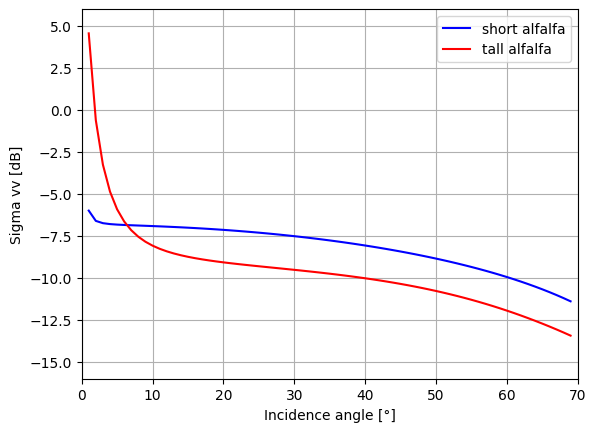
# plot backscatter changes for short and high alfalfa based on the incidence angle
fig = plt.figure()
ax = fig.add_subplot(111)
ax.plot(theta_deg, 10.*np.log10(back_short), label='short alfalfa', color='b')
ax.plot(theta_deg, 10.*np.log10(RT.stot[pol]), label='tall alfalfa', color='r')

ax.legend()

ax.grid()
ax.set_xlabel('Incidence angle [°]')
ax.set_ylabel('Sigma vv [dB]')
ax.set_xlim(0.,70.)
ax.set_ylim(-16.,6.)

plt.show()
5. Oh04+WaterCloud for different incidence angles
5.1 Input parameters for the RT model combination
# Parameters for both models
theta = np.deg2rad(40) # incidence angle [radians]
f  = 5.3 # Frequency [GHz]

# soil parameter
s = 0.3/100. # surface roughness [m]
mv = np.linspace(0.01,0.4) # soil moisture [m³/m³]
# calculations
lam = f2lam(f)  # wavelength [m]
k = 2.*np.pi/lam # radar wave number
ks = k * s

# canopy parameters
A_vv = 0.0950 # empirical parameter - need to be optimized for each test site
B_vv = 0.5513 # empirical parameter - need to be optimized for each test site
A_hh = 0 # empirical parameter - need to be optimized for each test site
B_hh = 0 # empirical parameter - need to be optimized for each test site
A_hv = 0 # empirical parameter - need to be optimized for each test site
B_hv = 0 # empirical parameter - need to be optimized for each test site

V1 = 0.02 # parameter describing the canopy (todo: find realistic values)
V2 = np.linspace(0.5,5) # # parameter describing the canopy (todo: find realistic values)
5.2 Forward modeling of RT model combination Oh04 and WaterCloud
# Define models and polarization to be used
models = {'surface' : 'Oh04', 'canopy' : 'water_cloud'}
pol='vv' # target polarization

# Soil model initialization based on previously defined input parameters
S = Soil(f=f, s=s, mv=mv)

# Canopy model initialization based on previously defined input parameters
C = OneLayer(A_vv=A_vv, B_vv=B_vv, A_hh=A_hh, B_hh=B_hh, A_hv=A_hv, B_hv=B_hv, V1=V1, V2=V2, d=1, ks_v=1, ke_v=1, ke_h=1, canopy=models['canopy'])

# Combined Model initialization
RT = RTModel(theta=theta, models=models, surface=S, canopy=C, freq=f)

# Run RT model
RT.sigma0()
backscatter_vv = RT.stot[pol] # total modeled backscatter
backscatter_vv_g = RT.s0g[pol] # modeled ground contribution
backscatter_vv_c = RT.s0c[pol] # modeled canopy contribution
WARNING: Permittivity cannot be calculated due to missing soil texture!
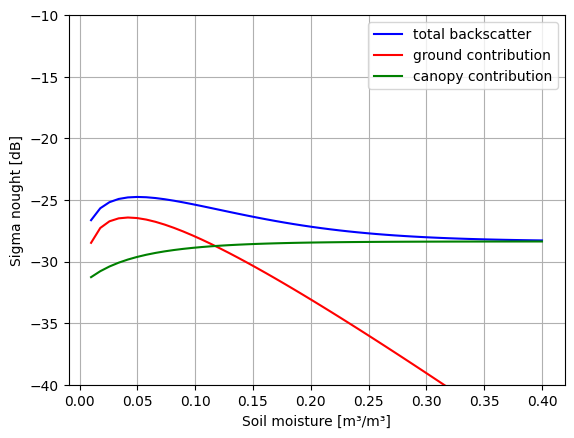
5.3 Visualization
fig = plt.figure()
ax = fig.add_subplot(111)
ax.plot(mv, 10.*np.log10(backscatter_vv), label='total backscatter', color='b')
ax.plot(mv, 10.*np.log10(backscatter_vv_g), label='ground contribution', color='r')
ax.plot(mv, 10.*np.log10(backscatter_vv_c), label='canopy contribution', color='g')

ax.legend()

ax.grid()
ax.set_xlabel('Soil moisture [m³/m³]')
ax.set_ylabel('Sigma nought [dB]')

ax.set_ylim(-40.,-10.)

plt.show()